
The Food Doctor
Nancy Irven, D.C., is teaching Florida students how to appreciate real food.
By Holly O’Dell
Since 1995, Nancy Irven, D.C., has offered in-depth nutritional counseling to adult patients at her practice, Irven Chiropractic Health Center in Crystal River, Fla. Little did she know, however, that she’d be taking her healthy-eating message to a new audience: 14-year-olds at the local high school.
In 2000, Irven became a board member for Crystal River High School Health Academy, designed for students interested in pursuing a health care career. At one meeting, Irven and her fellow board members were discussing their concern over how poorly kids were eating and brainstormed how they could help. Their first idea: Replace the high-sugar beverages and snacks from the school’s vending machines with more nutritious alternatives. But the group hit a dead end. “We realized that wasn’t going to happen because of the power of the companies placing vending machines,” recalls Irven.
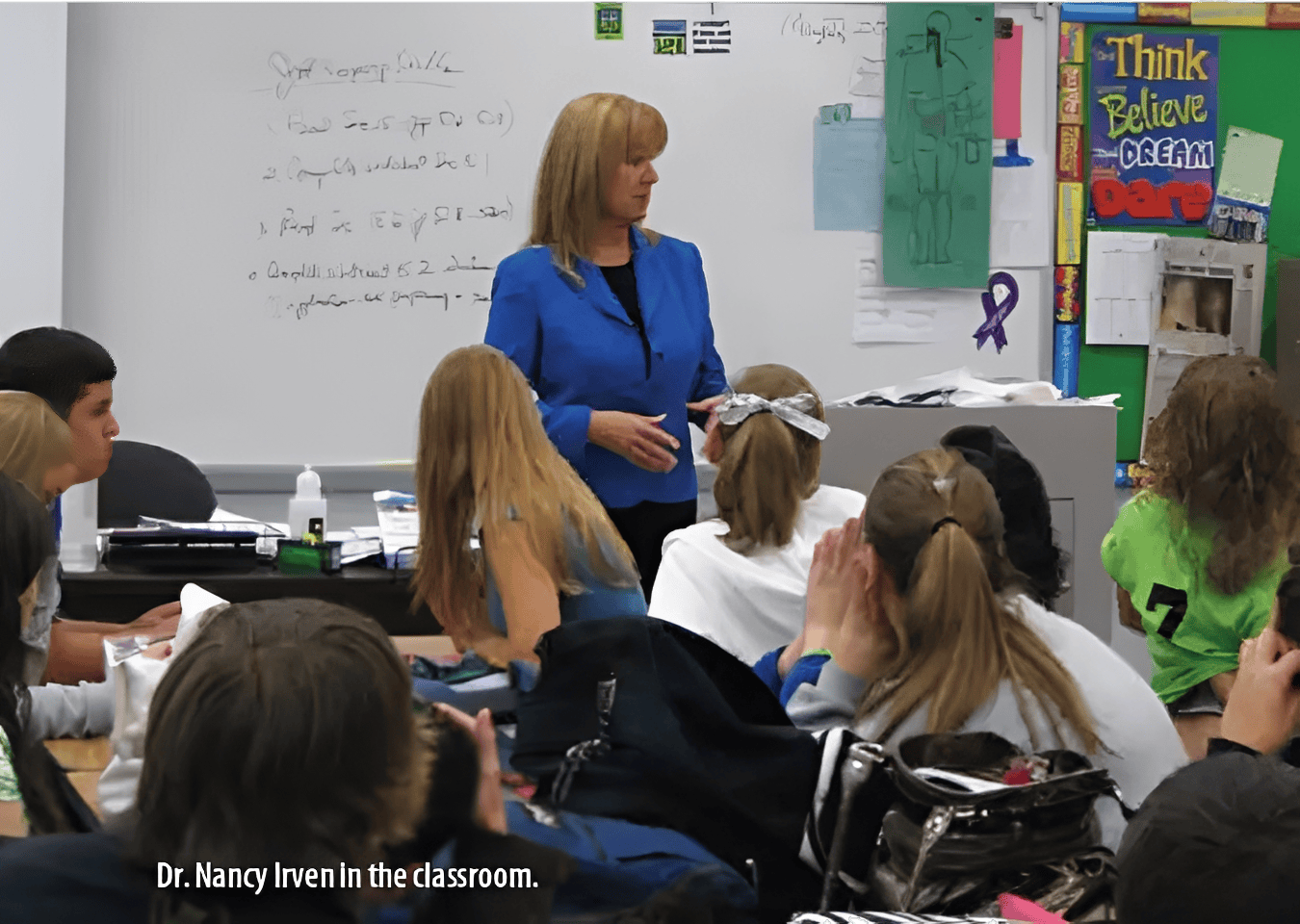
The school’s director—a friend of Irven’s who had encouraged her to join the board—then asked if Irven would be willing to come to her English class to explain nutrition to the students. Before talking to the freshmen, Irven asked each of them to keep a diet diary of everything they ate and drank for three days. She highlighted the students’ positive food choices and returned the journals to them. “Many of them were shocked that there were so few highlighted [meals],” Irven says.
Irven used the diaries as the launching pad for her first class. She brought in some of the unhealthy foods that populated many of the journals and passed them around to show exactly what they were eating. Specifically, she taught the students about the dangers of refined grains and sugars, trans fats and high-fructose corn syrup, which compose thousands of pre-packaged foods. As part of the process, the students learned how to read ingredient labels. Irven continued her interactive approach by asking the teens to name vegetables, fruits, legumes, meats and so on, and then write down the ones they liked.
And this was all just part of her first 90-minute talk with the students. For her second session, Irven decided to feed the students. She brought in items for sandwich making, such as sprouted grain bread, roast beef, tomato slices, lettuce and cheese. Other foods available for the taking included peanut butter, bananas, pecans and almonds. “Some of these kids had never even tasted raw nuts,” Irven recalls. The chiropractor also showed the teenagers how to cut up raw fruits and vegetables and even made them fruit smoothies. Students reported feeling better after having a nutritious meal; the high school football coach noticed improved focus among his players who ate food in Irven’s class. Her third lecture served as a follow-up to the first two talks, where the kids could ask additional questions about nutrition.
Irven’s classes opened the teenagers’ eyes. “By the end of the first lesson, the students had an idea of the predominant ingredients in the foods they were eating,” Irven says. “They were completely unaware of any of this information, and they started asking questions like, ‘If this stuff is so bad for us, why don’t our parents know?’”
Some of the students took this question into their own hands, sharing what they learned from Irven with their families. “Parents were getting involved and would take their kids grocery shopping,” Irven says. “The reactions I got from them were always very positive because they were excited that their kids were coming home asking for things that parents had long ago stopped trying to get them to eat.”
Anthony Bower was one such student who took the information he learned directly to his father, Tony, and stepmother, Rose. Anthony, now a 17-year-old junior, participated in Irven’s classes his freshman and sophomore years.
“Anthony came home and started telling me that everything I was eating was actually bad for me,” Tony recalls. “He pointed out the trans fats and all the things I didn’t want to know about the foods I ate.” But Tony and Rose quickly got the message. “All of a sudden the student became the teacher,” Tony says. “So we started to purge the cupboards.”
“It was painful for my dad,” Anthony adds with a laugh. The Italian family switched out its beloved semolina pastas and white breads for whole-wheat alternatives. Gone were the frozen and prepackaged meals, replaced by fresh, whole foods.
The nutritional shift paid off in dividends. The whole family lost weight, and Tony’s cholesterol levels improved dramatically. They report having more energy, getting up earlier and being more active. Anthony’s parents never once questioned his commitment to the cause. “Anthony came home showing a lot of compassion,” Tony says. “He wanted to see us live long, healthy lives, to be there for him and someday his future family. How could you not buy into it?”
EXPANDING HER REACH
To further enlighten parents on what their children were learning, Irven wrote a book called Please Don’t Eat the Wallpaper. The book—named after Irven’s realization that her mother used the same flour in baking and cooking as a base for wallpaper glue—outlines the message she delivers in the classroom.
“Please Don’t Eat the Wallpaper” now serves as required background reading for the nutrition classes Irven continues to teach at the Health Academy and another school, the Crystal River Environmental Academy.
Irven’s grassroots approach has reached beyond the borders of Crystal River. Administrators at the Salk School of Science in Manhattan ordered 120 copies of the book for their students. HealthCorps, founded by Dr. Mehmet Oz, has asked Irven to give a presentation to the group, which aims to stem the childhood-obesity crisis through school-based health education and mentoring.
Seven years after teaching her first nutritional class, Irven remains motivated because she sees “so many people who are just a slight shift away from feeling really bad to feeling really good. There are 14-year-olds who have terrible digestive problems. They have learning disabilities. Their quality of life makes me want to cry. I get to know them individually, and I know that it can be so simple to just make a few changes in their diet.”
These days, Irven finds that although students are more familiar with terms such as trans fat and high-fructose corn syrup, they still lack basic information on how to be healthy eaters.
“Food is being taught to them as carbohydrates, fats, proteins, calories,” Irven notes. “It’s being taught as, ‘This little Oreo cookie package here only has 100 calories, so this is better for you.’ But there is absolutely no connection to quality calories.”
Furthermore, much of the nutritional education that teens receive focuses on the cannot’s versus the can’s. “These students are overwhelmed with people telling them, ‘You can’t have MSG and you can’t have red food coloring and you can’t have yellow dye,’ but what can you have?” Irven asks. “So I brought it down to where they could touch the food, feel it and experience it. And many of the students have made substantial changes in their diets. We need to continue to help kids understand the incredible nutritional quality of real food.”
Hear Real Nutrition Success Stories
Learn how Dr. Nancy Irven's book and classes inspired
Need for Different Approach Teaching Nutrition
“I am saddened when I read the writings of experts who say that getting high school students to make any dietary changes is “virtually a waste of time”. I disagree. It is my opinion that we must change our approach to teaching nutrition.
As long as they are getting the same generic and conflicting advice (reduce saturated fat and eat more vegetables, but don’t put butter or salt on them, but drink more milk) they will continue to make detrimental choices. They study how to decipher the information listed in the nutrition facts box, but don’t see why the choice for the lower fat often means higher sugar. They don’t understand that it really doesn’t matter if the product has a few less grams of carbohydrates or fats. They are still eating glue and plastic. (Also referred to as ultra-processed chemicals)
The practical application of a nutrition class is for the students to eat better and be healthier, but it is lost in charts, percentages and long lists of words referring to isolated nutrients that are not whole foods. I think teens need a more tangible motivation to give up French fries and soda in favor of healthier meats, vegetables, and fruits. I taught them they were eating glue and plastic, because that has an impact on them.
When I see their noses wrinkle, hear the gasps of shock and see the looks of disgust on their faces, I know they progressed at least one step forward. These non-nutritive products will not look the same to them.
I teach about superior nutrition because I want to encourage people to feed themselves and their children as if Eternity was looking over their shoulders.
Excerpts From Letters Written by Students
“Dear Dr. Nancy,
You surprised me! I thought when Mrs. Powell told us that we were going to be learning about nutrition, that we would be learning something pretty boring. Not something life changing! I can’t tell you how much this helped my family and I eat better…”
“Dear Dr. Nancy,
It takes a special person to help save other people. You knew that one day we would all be in trouble with our health because of our eating habits. You took the time , money and effort to teach us how to make better choices…”
“I have been reading lots of labels and have been making my own fresh fruit smoothies. Before you came to speak to us, I never ate breakfast and I ate tons of trans fats. I feel so healthy now and I have lots of energy…”
“You may have saved some of our lives by teaching us the right foods to eat so we don’t end up with heart attacks, diabetes or stroke… Please continue to educate people in the future on good nutrition and help to maybe save their lives too.”
“Who know that you could make healthy snacks that are made in minutes and cost next to nothing? I also found myself not very hungry the rest of the day, which is very good for me because I always find myself eating and grabbing another snack. Thanks to you I may be adding a few years on to my life by eating healthier…”